
As an instructional designer in eLearning with more than 15 years of experience, I have been asked to convert ILT to eLearning in different engineering occupations. This requires using best eLearning instructional design practices since in some cases the training has elements that only work in an in-person setting. The online training development required the design of an effective process, which I present in this blog post.
Converting traditional instructor-led training (ILT) to eLearning isn’t just a trend, it’s a smart strategy for learning teams who need scalable, measurable, and learner-centered solutions. With remote and hybrid work growing rapidly, organizations struggle to provide consistent training across locations and time zones. A 2021 study found that eLearning improves retention by up to 60% compared to 8–10% for classroom training, and reduces training time by 40–60% due to its self-paced nature and multimedia design (TalentLMS). This shift is particularly critical for compliance training, like OSHA safety courses, where both accuracy and engagement impact worker safety and organizational risk.
The Need to Convert ILT to eLearning
1. Workplace Shifts Demand Flexible Learning
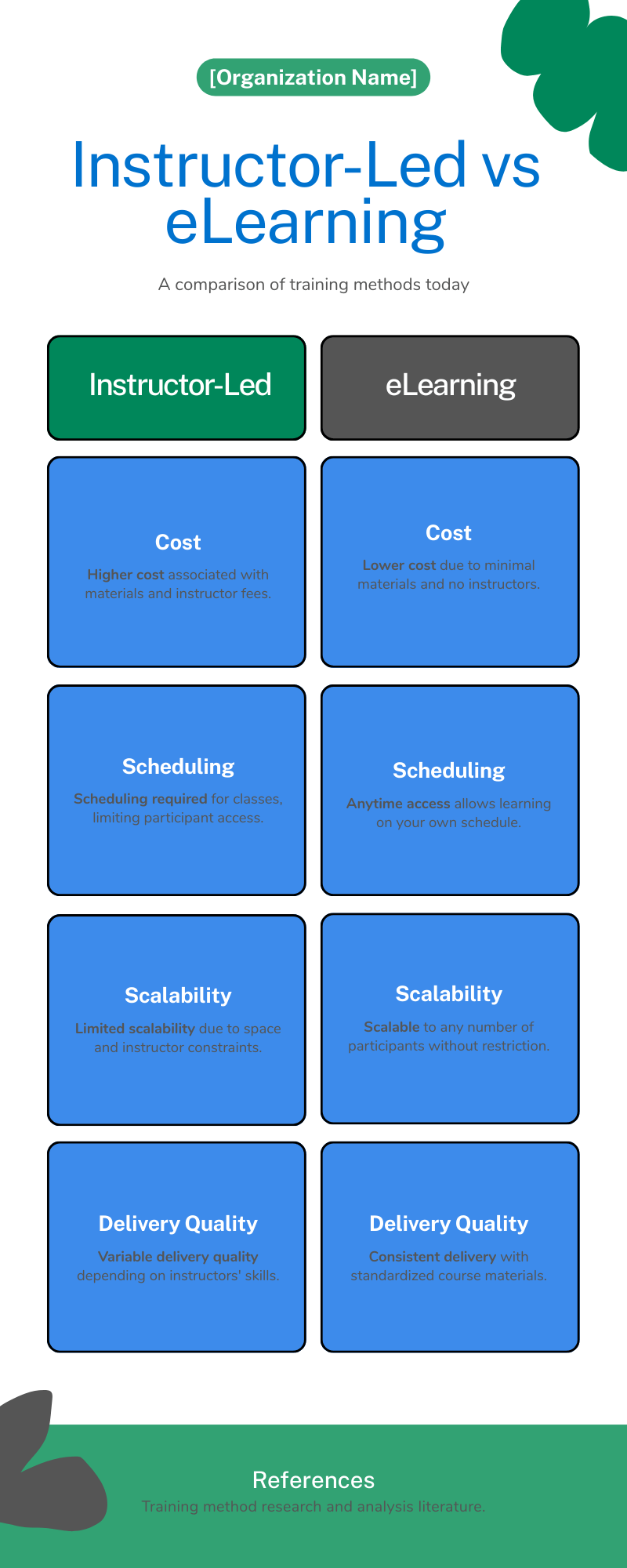
Remote and hybrid workstyles mean employees may not be available for scheduled classroom sessions. eLearning gives learners access to content anytime, anywhere, from desktop or mobile, making it easier to fit training into the flow of work. Just consider you need to apply best eLearning instructional design practices to make an effective conversion in your training.
2. Consistency, Scalability, and Standardization
ILT content delivered by different facilitators can vary. eLearning ensures every learner gets a consistent experience with standardized content and assessment. And you achieve this consistency during the online training development process.
3. Cost and Time Efficiencies
Traditional ILT involves travel, facility costs, and facilitator time. According to eLearning Industry research, organizations that adopt eLearning can reduce costs associated with training delivery by up to 70% while scaling training to more employees without proportional budget increases.
Source: “Top 10 Benefits of Converting ILT to eLearning”, eLearningIndustry:
4. Data, Tracking & Compliance
With eLearning hosted on an LMS (Learning Management System), tracking completions, quiz scores, and compliance status becomes automatic. This is essential for regulated training like OSHA safety compliance. In a previous post, I laid out the issues that you need to consider to select an LMS.
Step-by-Step Process to Convert ILT to eLearning
Below is a step-by-step workflow that ensures you convert ILT to eLearning that is effective and provides the high impact in the training program. We’ll apply each step to a workplace safety compliance course (OSHA training).
Step 1: Conduct a Needs Analysis
What to Do:
Before conversion, assess what the ILT currently does, and doesn’t, achieve. Meet with stakeholders and subject matter experts (SMEs), analyze performance gaps, and define learner characteristics. This is the beginning of the online training development.
Questions to Ask:
- Who is the audience (new hires, field workers, managers)?
- What must learners be able to do after training (e.g., recognize hazards, use PPE, follow emergency protocols)?
- What are compliance requirements?
Outcome:
A documented Training Needs Analysis (TNA) that informs decisions throughout design.
OSHA Example:
Interviews with supervisors reveal that employees can recite safety rules but often fail to apply them during audits. The training must therefore shift from passive information transfer to applied scenario learning.
Step 2: Define Learning Objectives
Clear objectives guide design and evaluation. Use actionable verbs aligned to performance. Use eLearning best practices and sound eLearning instructional design principles.
Format:
“By the end of this module, learners will be able to …”
OSHA Example Objective:
By course completion, employees will correctly identify at least 5 common workplace hazards with 90% accuracy using scenario-based activities.
Step 3: Select eLearning Tools & Delivery Format
The right tools empower great experiences.
Common Tools:
- LMS: Moodle, Canvas, TalentLMS (for hosting, tracking, compliance reporting)
- Authoring Tools: Articulate 360 (Rise & Storyline), Adobe Captivate, iSpring Suite
- Media Tools: Vyond or Powtoon (animations), Adobe Photoshop/Illustrator (graphics), Canva (quick visuals)
- Assessment: LMS quizzing, interactive branching logic
Delivery Formats to Consider:
- Microlearning modules (short, focused chunks)
- Scenario-based learning
- Video simulations
- Interactive quizzes
OSHA Example:
Choose Articulate Storyline to build interactive hazard recognition scenarios and publish the course as SCORM/xAPI to the LMS.
Step 4: Redesign the Content for Online Learning
Don’t simply upload slides. Transform content into engaging, bite-sized, interactive learning. In my experience, this was the bulk of the work needed to convert ILT to eLearning.
Best Practices:
- Chunk information into 3–7 minute modules
- Add interactivities every 60–90 seconds
- Replace long narration with visuals and scenarios
OSHA Example:
Original ILT had a 90-minute lecture on hazard classification. Convert this into four modules:
- Hazard Recognition
- Personal Protective Equipment (PPE)
- Emergency Protocols
- Incident Reporting
Each includes scenario practice and knowledge checks.
Step 5: Build, Review, and Iterate
Develop a rapid prototype, test with SMEs and target learners, then revise.
Checklist:
✔ Is navigation intuitive?
✔ Do interactions reinforce objectives?
✔ Are knowledge checks aligned to real tasks?
OSHA Example:
Pilot test with a small group of warehouse employees. Based on feedback, adjust graphics for clarity and improve feedback messages in scenario interactions.
Step 6: Deploy on the LMS
Publish the final course package (SCORM or xAPI) and upload to your LMS.
Deployment Steps:
- Set course prerequisites
- Configure completion and passing criteria
- Assign learners and groups
- Enable reporting dashboards
OSHA Compliance Tip:
Use LMS compliance tracking to automatically notify managers when certifications nears expiration or retraining is required.
Step 7: Evaluate and Improve
Training evaluation is ongoing.
Models to Use:
- Kirkpatrick’s Four Levels: Reaction → Learning → Behavior → Results
- LMS analytics (completion rates, quiz scores)
- Post-training surveys

OSHA Example:
Three months after rollout, measure incident reports and hazard audit scores. Notice a 30% drop in unreported hazards, signaling training behavior change.

Research & Further Reading (with Links)
These studies and articles explain the value of converting ILT to eLearning and the outcomes you can expect:
- Top 10 Benefits of Converting ILT to eLearning eLearning Industry
- How to Convert Instructor-Led Training to eLearning eLearning Industry
- 6 Strategies to Convert Compliance Training to eLearning Adobe Blog
- 47 eLearning Industry Statistics and Trends Brandon Gaille (supports market and retention claims)
- Cost Comparison Model: Blended eLearning vs Traditional Training PubMed
- The Benefits of eLearning in Organizations TalentLMS (retention and time savings data)
Conclusion: Conversion = Transformation
Converting ILT to eLearning is not just a format change, it’s a learning transformation. By analyzing needs, setting measurable objectives, choosing the right tools, and designing with learner engagement in mind, you’ll build online training that scales, tracks results, and drives real performance improvement.
If you’d like a free ILT to eLearning checklist or example storyboard template, just let me know!